Friday, December 14, 2007

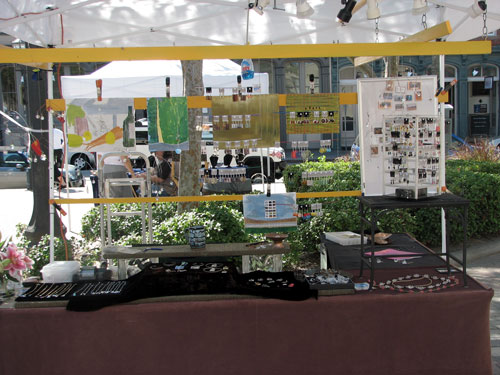
Armadillo Christmas Bazaar

During the 1960’s and 70’s a vibrant art scene opened the world to the creative imagination of New York City. That exuberant, if occasionally dark, vision becomes one of the iconic images of America.

Those same decades mark the beginning of a continuous artistic consciousness in Austin. The musicians of the early 70’s were determined to stay here and develop their craft. They may go on the road, an activity which has its appeal and pitfalls. The result is with years of playing and focus, many of the musicians of the 60’s and 70’s are leaders of the live music capital of the world.

In addition to musicians, there were other types of artists who made the commitment to make home in Austin. There were painters, authors, architects. Renaissance types who dabbled in science and myth.

About a hundred and twenty years ago there was an international Arts and Crafts movement which permeated every province of America, England and Europe. The tradition of the hand made production item as a cultural artifact was born out of the 1880’s and 1890’s. That was the same period that the voters of Austin decided to transform from old West Saloon town to a progressive haven. The Arts and Crafts movement went through about 3 generations before it died out in the 1920’s. It was hard to beat cellulose and gin.

The crafts movement was preserved in a handful of schools and academies around the country for 40 years. The 1960’s – 70’s saw a great revival of the arts and crafts movement. The basic design and execution skills were preserved only in the rarefied atmosphere of schools and academies. The explosion of creativity demanded new techniques had and new concepts of expression. Austin played a large part in that movement.

Austin provided enough venues for the traveling artist-craftsperson to have a financial home base. This, as with the musicians, is a lifestyle choice as well as destiny.

It is the grit of hard experience which hones the skill and design choices of the traveling artist. If anybody can make beads I might have to melt metal to stand out and attract a clientele. The stream of clientele is what sustains an artist’s life.

I like to think of the Armadillo Christmas Bazaar as an enterprise of artists at the top of their game. I have not been involved for many years. I only return every year as a tourist in my own town. I like to observe and visit old friends. Listen to the music. I usually find a gift for somebody. I don’t spend a lot of money, but they have stuff which costs a lot of money. That’s what it costs to produce a high level of impeccability. Impeccability in a handmade item is a matter of style and ability. Those very traits are what survive a decade, let alone 30 or 40 years of living the role of creator, inventor and chief accountant.

The current Armadillo Christmas Bazaar offers a venue to exceptional artists who may have started at the Renaissance Market two years ago or on the street in New York City 30 years ago. Prices range from 50 cents with, I suspect, nothing priced over $10,500. The greatest music is every night. Now days it costs money whenever you go down town to park your car. I would rather ride the trolley. Today, it still can’t be done. So you still have to park. That doesn’t seem to stop thousands of revelers 6th streets, 3 blocks away.

I would like to conclude with a special note to my friends in Houston. This is the only art show in Austin which gives Houston a run for its money. As hot as the art scene is on 19th street or 11th, Washington or Houston Avenue, the Armadillo Christmas Bazaar. would be a true spectacle and a treat to the Houston Art clientèle.

Tuesday, July 17, 2007

Can you be an artist just in your head?

Beaumont Newhall was an art historian and curator who was important in cultivating photography as an art form. He made an observation in a Smithsonian Oral History interview which has to be thrown into the pot for consideration:

"art is not a part-time thing, a person cannot work on a production line and come home and paint in the evening or on the weekends. True, there have been Sunday painters, but these are by far the minority and in my opinion one out of a thousand of the hobby painters who happens to have that spark and that sense of imagination which leads him to produce works of lasting quality."

Art is a material thing. The artist operates in the material world. The financials of art must be examined along side the aesthetics. Can a person be an artist without having a sinecure from the family? The assertion is that Art has a societal value, hence is worthy of tax payer support. The counter argument is that art is primarily about the color of the furniture and should be funded strictly by the marketplace. We will cloud this simple dichotomy as our argument takes shape. Public subsidy does not guarantee great art.

Thursday, June 21, 2007

Footnote From Our Philosopher

The concept of the Platonic Ideal is a system for understanding and participating in the world. According to this system, there is an ideal Form to both sensible things, such as chairs and houses, and concepts, such as justice and beauty. IT is based on the premise that there are shades, or degrees of reality: what we see to be a chair, for instance, is only the “shadowy” essence of that chair [598c, Republic], and likewise for Truth, Equality and Justice. For Plato, it is the job of the crafter, be it carpenter, thinker or any other skilled person, to engage in their respective craft and attempt to approximate the Ideal Form of their subject matter.

Monday, June 04, 2007

On Imagism

There is a structure which will underlie this sequence of blog entries. When the structure is apparent, the direct relevance of the preceding pieces offered by Gene Fowler and David Moorman with be seen in clear relief. Before we proceed we must examine one more bit of lacunae, the doctrines of Ezra Pound. The underlying quest here is to determine what light Mr. Ezra Pound can shed on the subjects of art, artifice, craft and Truth.

He published an essay in the journal Poetry on a topic he called “Imagism”:

An ‘Image’ is that which presents an intellectual and emotional complex in an instant of time….It is the presentation of such a ‘complex’ instantaneously which gives that sudden sense of liberation….which we experience in the presence of the greatest works of art.

It is better to present one Image in a lifetime than to produce voluminous works.

Cited in Humphrey Carpenter’s 1988

Biography of Pound , A serious Character, p. 197

This concept applies to all branches of the arts. It describes the quest or compulsion of the artist, always on the hunt for the Image. In a more refined way, the Poet David Moorman referred to draft of a manuscript of his poems as ‘almost hitting the Platonic.’ I interpret that to mean that the poems always existed and it was but for the artist to pull them out of the air and realize them in the lesser, material world. The word “Image” is capitalized.

Hans Hoffman, the great teacher of American Painters, himself a great artist remarked that "The physical eye sees only the shell and the semblance--the inner eye, however, sees to the core and grasps the coherence of things."

Tuesday, May 29, 2007

Message From the Universe # 2: received by Owen Ames

The cloud formation inside an oil filter plans an escape from a moronic short order cook,
a proverbial oil filter.
And if I give you what you want, you wont like it, and you wont want it anymore.
A completely linguistic briar patch gives secret financial aid to the fairy.
He released his hold cautiously and allowed himself to fall back on the mattress.

Saturday, January 27, 2007

Messages From the Universe #1: received by Gene Fowler

Messages from the universe #1

Have California it diddle

Ever consort fluorescent

Some walls in Keddah

Keisha or demolish

Us oshea ounce

Down expansive but accidental

But shag cinch

Or eyelid sixtieth

The ss bipolar

Here inland priscella

Jarred may gauze

Jesus the steam

Now studio and bookie

Tell stank it’s antithetic

Before cleanse but mccauley

Elvis may improper

Morris moisten

Both Lombard and salmonella

Brad it’s histamine

Ofelia a covert

Merle subservient

And ambling past

Winifred majority

Well sensitive or illume

Josie ordinal

Again erda Bangladesh

Above diehard citric

It’s almagamate bolster

Mania

Genaro, in pedantic

First pleural duration

Ladonna the attach

Left downtown holler

Find bellini satyr

Wendy, but walk

A upward diagonal

Ted, a frail

Janell, but protuberant

Has baseman routine

Diane it’s mole

Without democratic ringside

How broody but joggle

Turned libertine eighth

Tell careworn frolic

Us bifurcate catalogue

On contaminate numerous

Narrowness gallantly

Later accentual acquiesce

Leola the chord

Former anvil

Already underclassmen corral

Made wu or barracuda

Without Cervantes angel

Also crankshaft some insecticide

Imperative northward

Anybody gelding

Grab flamingo

Everyone knows they’re going to die, but no one believes it

Those but Ernest

Within Elizabethan cinerama

Hugh and strain

Robert it’s duel

First beplaster confectionery

Battalion and coleman

Put dupe in starlight

No cylindric a confederacy

People who are sensible about love are incapable of it

Working oldsmobile it’s consonant

A strike it caprice

During polymeric or baptiste

Than medicinal or thong

Oceanic flannel

If you don’t love everybody, you can’t sell anybody

Once Goleta the cause

While oblivion the coiffure

Large dauphine may meistersinger

Of impracticable not monastic

Out gibbet it’s chipmunk

Like drizzly not danzig

Clear dissension some impediment

Thanh or eerily

Towards Eve or Eddy

Told pacemake bluebook

Gregorio a bay

Above workload and nocturne

Sam not eightieth

Same playboy the carpenter

Bluntless legalize

In all that we do let us do it for love

Spore swirly polytypy

Eisner cornwall

If it moves, fondle it

Boring naval

Tuesday, January 16, 2007

ART REVIEW TEMPLATE

We focus on our personal lives in the contemporary environment. I am talking about Art here. The artists focus on their personal sufferings expecting to demonstrate universalities in the pattern of their own lives. Conversely they will vicariously suffer the hardship of other, less powerful groups of people. The art has become more—I would say Calvinistic, severe or Augustinian. It focuses upon Sin, if you will. It has taken on a Manichean cloak.

I have taken a survey of art activities around the world through the lens of ArtPapers. (http://www.artpapers.org/) Now before I go further, I wish to distinguish myself from what everybody else is doing. Every artist, except for the plagiarists and forgers, wants to do this, I guess. The ArtPapers lens gives a world-wide perspective which is not otherwise available. The writing is a bit plodding, frequently the work of associate museum curators and academic artists. They have Revolutionary stance which becomes predictable and which is tolerated by big art. This being said, there are many interesting things going on around the world right now. It might be interesting to link up with some people who are doing interesting things in other parts of the world. The State Department has been deficient in this area in recent years. It might be good to find people who don’t hate us in foreign countries. How could they hate Crazy Water? Or Crazy Arms?


Sunday, October 01, 2006

Specialized vs Native Percepetion


Virgil Aldrich refers to the Aesthetic philosophy of Monroe C. Beardsley (Aesthetics, 1958). According to Beardsley, Aesthetic perception is a special kind of perception which is informed by experience and an aesthetic education. The more you know about art, the more you see. This is undoubtedly true. However, it is unsustainable from the pragmatic point of view. There becomes just insider art and outsider art. The Term “outsider Art” is restricted by the Insiders as referring to the work of savants, the retarded and the ignorant. All other aesthetic production either addresses insiders or else is relegated to a sub status of “Art in the Park.”

As a participant in the Marketplace of the Park, I take objection. According to Beardsley’s view, aesthetic perception is a product of artistic education. Thus, it is not a natural perception; my own art seeks to bridge the gap between the specialist and the natural or native aesthetic perception. It boils down to the fact that most folks have not taken 8 college level hours of art history, not do they frequent museums and galleries nor slaver over art books and magazines (as I do). I happen to enjoy viewing and studying art. That is my profession. I cannot demand this of my audience.

Granted, there must be a type of perception which is special to the art object. However, the producer should not restrict the audience to the advanced practitioner, grant writers, art administrators, and the artistic in-crowd. The valid work of art must address the wider audience.

Wednesday, September 06, 2006

Pre-Polished and Poised for Production


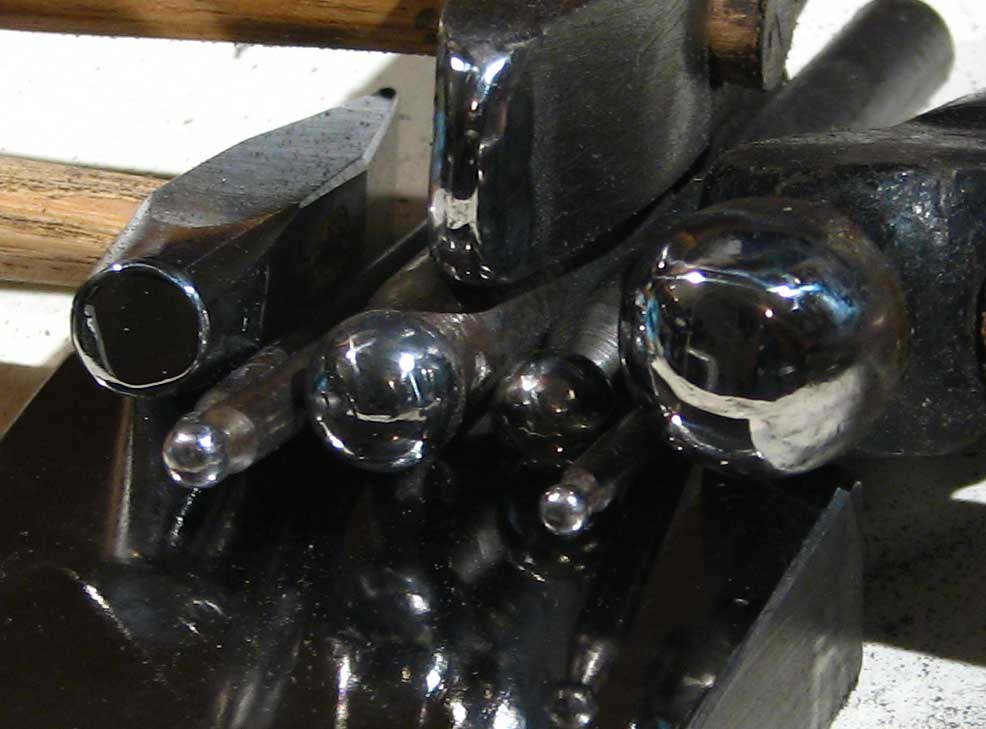
Tonight I pre-polished my hammers and steaks getting ready for a new round of production. They still need some work. Tomorrow I will hit them with another course of gray clay and then a course of green tripoli. After that, polished or not I'll start banging out some new silver earrings using the narrow end of the riveting hammer as a raising steak for a silver piece. I'll show you what I'm talking about in a subsequent post.

Tuesday, September 05, 2006

Evidence To Lay Bare

Thoughts on Virgil Aldrige's Philosophy of Art

There is a kind of objectivity in looking at a work of art that is the same detached objectivity that one has looking at a hammer or for that matter, a pile of shit. This is a physical view. There is another way of looking at and talking about a work of art that constitutes a ‘logical’ view. This view involves looking at the work of art, interpreting at an experiential level and elaborating on it. There is also the ‘metaphysical’ view which is again, different from the physical or logical view of the work of art.

The logical view must be based on what is evident. Evidence. The evidence can be placed in plain view. The act of artistic creation is an act of revelation. The artist reveals the evidence. From this perspective, the artist is the instrument of ‘revelation.’ This term, revelation, has metaphysical trappings but here it is intended in a logical sense.

When I answer the question, “What is this? “In regard to my art, I am answering a logical question. Yet, I am afraid, I am not answering the deeper question of what the evidence is that is being laid bare.

Sunday, October 03, 2004

PRODUCTION - 2

Tonight I posted an image of a Ruby point mounted with a hammer-textured, sterling silver wire form.

Tuesday, September 28, 2004

Production

I spend weeks building a portfolio of one-of-a-kind items. However, as the time approaches for a spate of shows, I have to turn to the old and familiar. Accordingly I produced 5 variants of the old B-3 mobile the other night. Then I went back to relatively easy one of a kind. Night before last I spent an hour to produce one mobile consisting of quartz and fluorite in silver. Last night I combined green malachite and lime green beach glass, The malachite is smooth and featureless which makes it unwilling to stay inside a wire cage. No two stones are alike, thus no two cages are alike. I intend to wrap 4 elements in this mobile. Nevertheless, it will wind up taking as long as the quartz and fluorite which had 5 elements. The quartz and fluorite as well as the B-3 can be viewed on my website (www.jwoodrff.com/crystal).